TURKISTAN, KAZAKHSTAN
Turkistan’s Modern Makeover
One of the key cities during the Asian Silk Road period is reinventing itself
The city of Turkistan (also spelled Turkestan), meaning “land of the Turks,” lies in southern Kazakhstan and ranks among the region’s most historically significant yet rapidly changing cities. Its biggest challenge is balancing a remarkable historical legacy with ambitions for modern development. I originally expected my visit to focus mainly on Turkistan’s influential role along the Great Silk Road and its rich spiritual history. Instead, I found myself increasingly drawn to the city’s striking transformation since 2018, when the Kazakh government began major revitalization efforts aimed at reinventing Turkistan as a regional hub for the future.
Table of Contents
Turkistan at a glance
- Rebuilt after the devastating 1966 earthquake into one of the Soviet Union’s showcase cities
- Home to Central Asia’s most impressive metro system, famous for its Soviet-era themed stations
- Rapid economic reforms since 2017 are reshaping the skyline with new offices, malls & mixed-use developments
- Combines Soviet monumentalism and brutalist landmarks with emerging modern consumer culture
- Less Silk Road romanticism than Samarkand or Bukhara, but offers a more revealing look at modern Uzbekistan
Ancient roots of the Silk Road city
Archaeological evidence suggests the region now known as Turkistan dates back to the 4th century, with a formal settlement established around 490. Historically known as Yasy, the city rose to prominence due to its strategic location along the Great Silk Road. This position helped transform Turkistan into a flourishing centre for trade, learning and cultural exchange during its heyday between the **12th and 16th centuries.
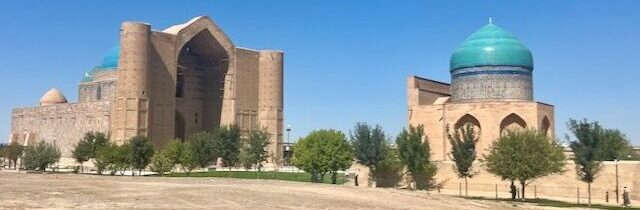
A pivotal figure in the city’s development was the revered Sufi thinker, poet and mystic Khoja Ahmed Yasawi, who made Yasy the centre of his preaching. His influence helped turn the city into a major destination for Islamic learning and spiritual reflection, earning it the reputation of being the “second Mecca” of the Turkic world. Today, Yasawi is buried in the Mausoleum of Khoja Ahmed Yasawi, still the city’s defining landmark. Reflecting its historical importance, the mausoleum was added to the UNESCO World Heritage List in 2003.
Beyond Yasawi, 21 Kazakh khans and eight sultans are buried in the city, reinforcing Turkistan’s historical and political significance. Officially recognised as the spiritual capital of the Turkic world, the city continues to attract thousands of pilgrims each year. A local tradition even holds that visiting Turkistan three times is equivalent to one pilgrimage to Mecca, highlighting its enduring spiritual importance across the Kazakh steppes and wider Turkic region.
The decline of the Great Silk Road, driven by conflict and the rise of maritime trade routes, gradually reduced Turkistan’s importance as a thriving caravanserai town where merchants once rested, traded and exchanged ideas. Over time, the city shifted from a bustling commercial hub into a quieter provincial centre, leaving behind echoes of its former influence.
What visitors will find today
While Turkistan’s historical appeal remains, visitors may find the city’s offerings somewhat modest compared to the lively souks and bustling medinas found elsewhere in Central Asia and the wider region. The historic core is relatively small, with key attractions centred around the Mausoleum of Khoja Ahmed Yasawi [map] and a compact underground mosque, both located a few kilometres from the town centre. For just 500 tenge (around US$1.25), a combined ticket grants access to both, although casual visitors may only need a brief visit.
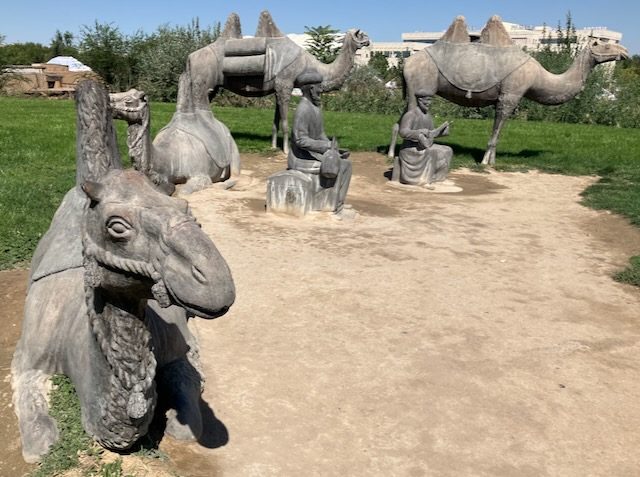
Beyond these historical highlights, much of Turkistan can feel surprisingly quiet, with the liveliest activity concentrated in the western part of the city, where many of the more affordable hotels and guesthouses are located. To reinvigorate the historic area, substantial investment has gone into improving its appeal, including landscaped parks, camel rides and a growing mix of accommodation and entertainment options. Yet despite the effort, parts of it can feel too artificial, as though tourism has been carefully constructed rather than evolving naturally over time. The centrepiece of these efforts is the Karavansaray Turkistan Tourist Complex, an ambitious mixed-use development anchored by a striking shopping centre aimed at extending visitors’ stays.
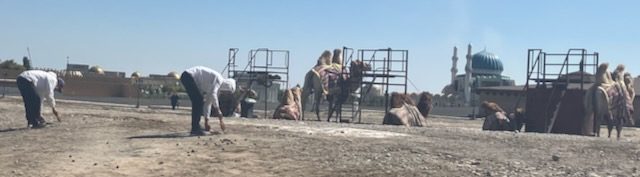
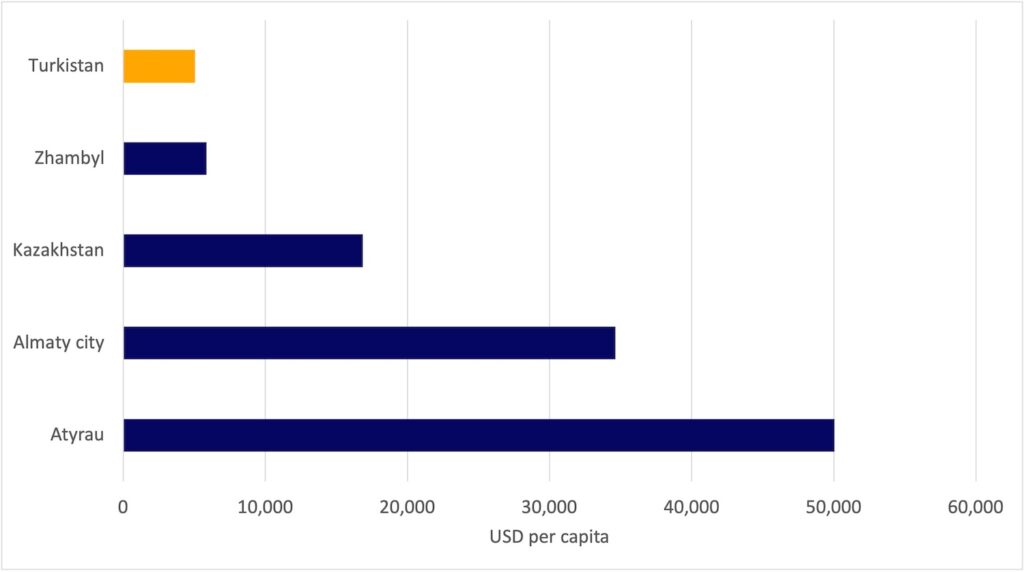
Chart: Turkistan Gross Regional Product in comparison 2025
Why Turkistan is being reinvented
While these modern additions may initially appear to dilute the city’s historical legacy, they have largely been viewed as necessary to reinvigorate Turkistan’s role in the region. The push for modernization began in 2018, when Shymkent, previously the largest city in the former South Kazakhstan Region, was placed under separate national administration. This reorganization elevated to regional capital status, with the area subsequently renamed Turkistan Region.
Positioned closer to Tashkent, the capital of Uzbekistan, than to either Almaty or Astana, Turkistan has a diverse population of around 224,000, with nearly half of residents estimated to be of Uzbek ethnicity.
Yet the wider region remains Kazakhstan’s poorest, with a gross regional product (GRP) per capita of less than one-third of the national average and roughly one-tenth that of oil-rich Atyrau Region. Historically dependent on cotton production, the regional economy declined as large-scale trade increasingly came under Russian control. However, the area also contains Kazakhstan’s largest uranium reserves, and industrial output has more than doubled in recent years, driven largely by mining and metallurgy. Much of Turkistan’s modernization effort is designed to harness this economic potential while repositioning the city as both a cultural and industrial hub for southern Kazakhstan.
The “special” growth experiment
The core elements of Turkistan’s growth strategy sit within a Special Economic Zone (SEZ) designed to attract investment through generous tax incentives. The SEZ includes an international airport opened in 2020, though flight options remain somewhat limited, alongside three industrial zones, one of which already hosts an established tenant base. It also encompasses the city’s historical and tourism areas, making it unusual in scope. Rather than focusing purely on industry, the zone extends into cultural and tourism development, making it one of the more ambitious SEZ models in the region.
Karavansaray: ambition meets reality
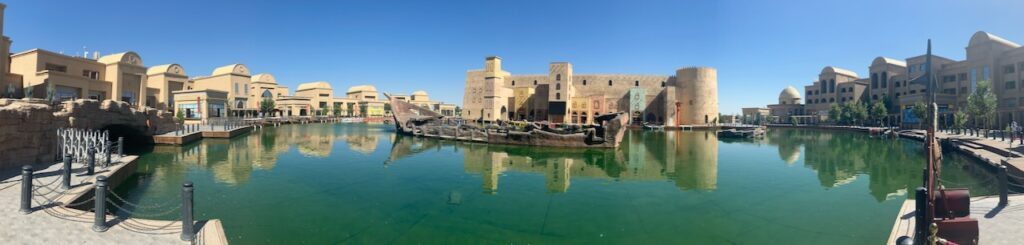
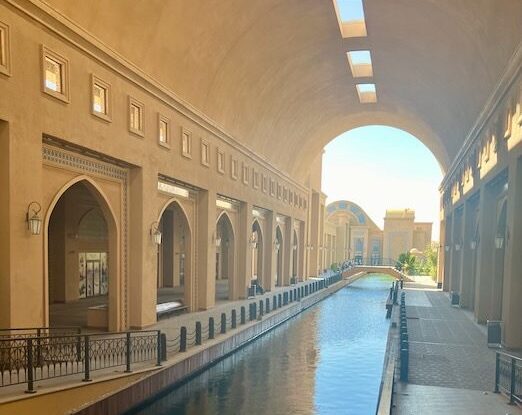
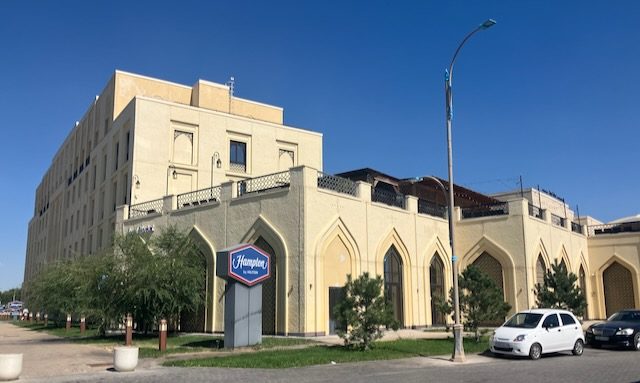
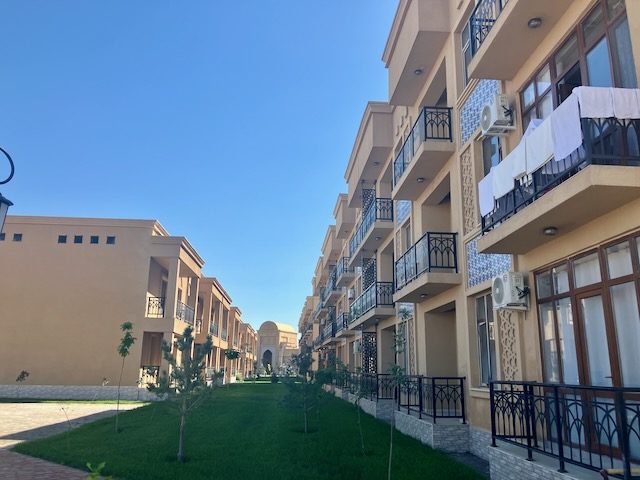
The Karavansaray Turkistan Tourist Complex, located a short walk from the historic sites, adds an extra dimension to the visitor experience. Named after the historic caravanserais that once dotted Asia’s trade routes, the complex centres around a large shopping mall built around canals and a lake. It also includes several high-end hotels and a cluster of attractive low-rise residential buildings aimed at buyers wanting close access to the area’s amenities.
Yet despite its striking appearance and the welcome respite it offers from the desert heat, the complex felt somewhat underutilized during my weekday visit. Many stores target the higher end of the market, while food and drink options felt surprisingly limited and often awkwardly positioned, with little outdoor seating. My hopes of sitting outside with a coffee to soak up the atmosphere quickly faded, as the only realistic options were just beyond the complex itself. Inside, the food court lacked appeal, and several peripheral areas remained noticeably empty. There is still some way to go before the complex feels genuinely lively enough to become a compelling destination for both visitors and locals.
Turkistan’s new city rising from the desert
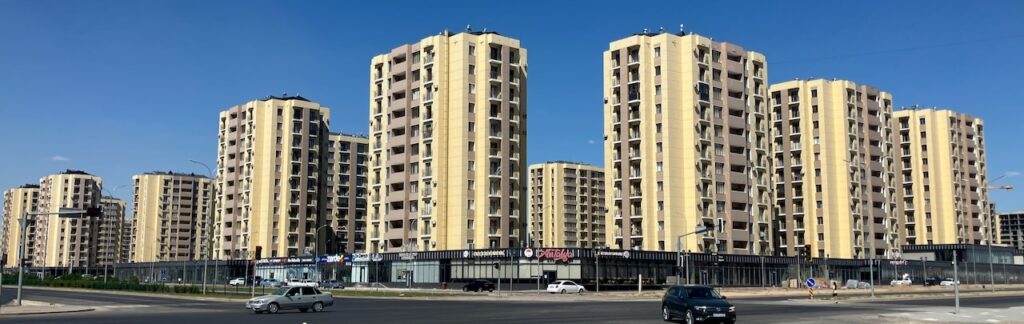
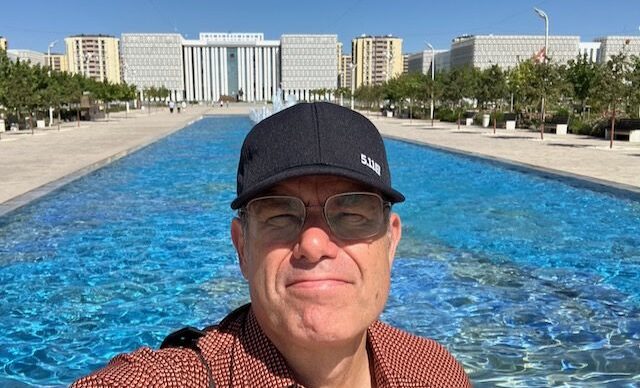
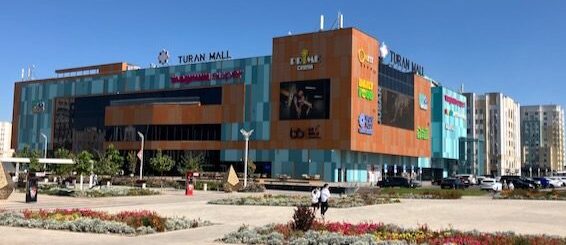
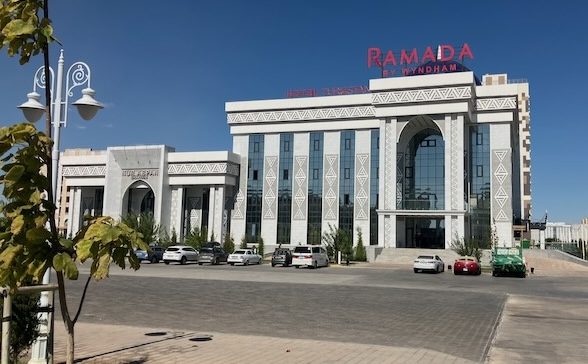
The biggest surprise during my visit was the ambitious new city emerging to the east of Turkistan’s historic core. Thanks to the city’s efficient bus system, I was able to reach the area quickly and cheaply. Spanning 6.7 million square metres, the district has already seen significant development, including offices for the new regional government, a four-star hotel, Turan Mall, and multiple residential blocks aimed at middle-income buyers.
Construction remains ongoing, with new apartment buildings rising rapidly, giving parts of the area a feel reminiscent of Astana, Kazakhstan’s purpose-built capital. Like Astana, this new district is becoming increasingly livable, with a growing selection of restaurants and cafés, a noticeable contrast to the more limited options in the older western parts of Turkistan.
For a city long associated with its Silk Road past, this new district offers a glimpse into a very different future. Visitors may arrive expecting to immerse themselves in history, but increasingly the reality is that Turkistan is not only preserving its past but actively trying to reinvent itself.

Travel tips for Turkistan
Turkistan is easily reached by overnight train from Almaty, with tickets and seat reservations available through the Kazakhstan Railway website. Just make sure you don’t turn up at the wrong station as Almaty has two train stations, a mistake that is easier to make than you might think.
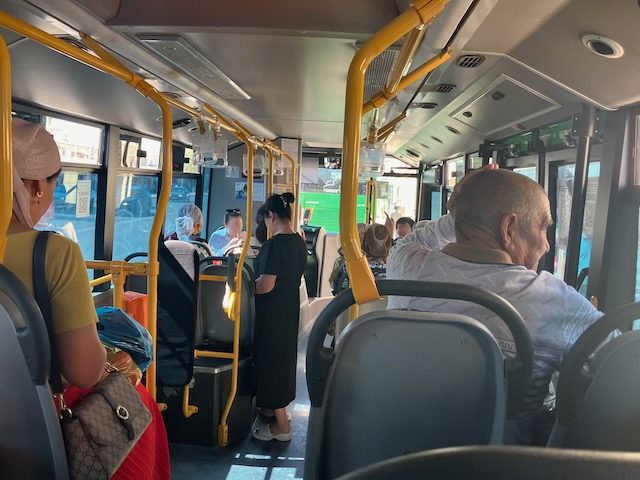
Once in Turkistan, getting around is refreshingly straightforward. Yandex taxis are widely available, or you can hop on the frequent local buses, which are cash-only (100 tenge as of 2026) and thankfully far less of a human Tetris experience than those in Shymkent. The network covers the city well, linking the historic sites, older commercial districts and the emerging new city to the east.
Accommodation is fairly spread out depending on budget and preference. The higher-end hotels cluster around the Karavansaray complex and newer eastern district, while more budget-friendly guesthouses and hotels tend to be found around the older commercial area.
For groceries, the city’s commercial districts have a few smaller supermarkets, but for a more substantial shop, the Magnum hypermarket [map] near the Karavansaray complex is probably your best option. While the older district where I stayed had only one coffee shop, a bit of a caffeine desert frankly, the newer eastern side of Turkistan is noticeably better supplied for your morning coffee fix.
Tonys' takeaway

While Turkistan is rightly famed as one of the key cities of the Silk Road, it was the growing modernity of Kazakhstan’s poorest region that I found more fascinating. The city’s relatively limited historical attractions have been given a polished makeover in an effort to put on a good show for visitors. While it is hard not to admire the ambition, it sometimes comes at the cost of authenticity.
That is perhaps why I found the brash, Astana-like new city more compelling. It feels better aligned with Turkistan’s ambitions to drive development in southern Kazakhstan and position itself as part of the 21st century and beyond, rather than simply trying to recreate the 12th.